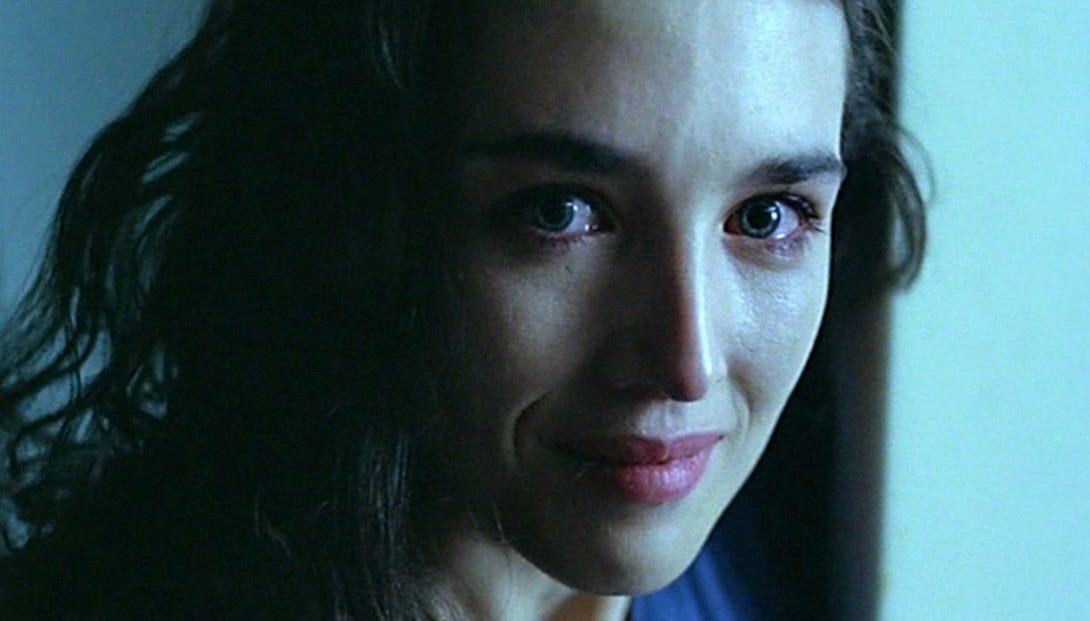
Possession - Introduction
The text of my introduction to Andrzej Żuławski's Possession (1981) at the Irish Film Institute yesterday evening.

Possession - Introduction
Good evening. Before we start, could we have a show of hands: who present has seen Possession previously? Okay, I ask this because when I started thinking about what to say here, I was confronted with the perennial problem facing anyone writing a film or book review, which is: how can you talk about a work of narrative fiction coherently, without giving the game away?
So, these remarks will of necessity be more general rather than specific, in order to avoid spoilers, and the film does rely on some surprising shocks for its effects. I’d be very interested to hear what people who have never seen it before have to say about it when the screening is over, so maybe – if you’re available, and interested, we can have a post-screening chat in the bar afterwards. I’ve seen the film at least half a dozen times now, and I find something new in it every time. However, this is my first time to see it on a big screen, so I’m very much looking forward to getting The Bigger Picture.
What is Possession, then, and what is it about? Well, it’s a slippery fish to categorise, genre-wise, which is one of its aspects which appeals to me the most. MUBI describes it, variously, as: ‘a monster picture, a marital drama, a tainted romance, a black comedy, an oblique espionage thriller and a psychotronic allegory’. It doesn’t even bother mentioning the most common, if reductive, designation: ‘horror film’. Released in 1981, it can be grouped with the work of other filmmakers at the time, like David Cronenberg and David Lynch, whose films were starting to blur the distinctions between high art and popular culture. Possession is situated half way between the art house and the grindhouse. This is the work of an auteur director which premièred in competition at Cannes Film Festival and for which Isabelle Adjani won the Best Actress Award, but which was also banned on VHS in Britain as a video nasty.
Essentially, it’s about a brutal marriage breakup, which has autobiographical roots, as that is what director Andrzej Żuławski was going through at the time he made the film. Indeed, when asked in interview what the film is about, Żuławski has said, ‘The film was my private life’, which he also described as ‘a banal situation’. There is a mundane plot buried inside all the histrionic absurdity. And where better to set such a scenario of a couple divided than in the divided city of Berlin in 1981? The Wall features prominently. One of Żuławski’s recurring themes, given his experience of growing up behind the Iron Curtain in Poland, is how societal evil begets personal evil. The film concerns a divided family, living in a divided city. Żuławski is fascinated by the latent horror of the everyday, and finds the domestic sphere to be the true locus of the unheimlich. But this perspective also has a reflexive relationship with a kind of cosmic, Lovecraftian horror, mirrored in an encounter with something which is beyond our comprehension.
One of the things that makes the movie great, in my opinion, is that it is so genre-defying (as well as defining): in his previous film, On The Silver Globe, Żuławski used the science fiction genre as a mask for a very human story, mostly because he had to keep his intentions sub rosa, for fear of encountering hostility from the Polish communist authorities. (In effect, the film wound up being censored at the time anyway, and he wasn’t able to complete the production until much later.) He was fond of quoting Descartes’ Latin phrase, ‘Larvatus prodeo’, ‘I advance wearing a mask.’ Genre cinema is a mask beneath which one can conceal one’s motives and advance ideas. With Possession, he uses the label Horror, or more specifically Body Horror, for his own purposes. Because of this, Possession is sometimes called, perhaps facetiously, a Creature Feature – a description underwritten somewhat by Żuławski himself, as when he was pitching for funding for the film he told one producer – and I’m sorry, but this is a spoiler that is too good not to divulge: ‘It’s about a woman who fucks an octopus.’
But it doesn’t stop there: taking place where and when it does, Possession also contains elements of the noirish spy thriller. And, depending on how you choose to interpret it, it can also be read as a savage satire on new age beliefs and practices, the ‘blah, blah blah’, as one character puts it, of much contemporary ‘wellness’ discourse. It could even be seen as a commentary on child-rearing, and the unintentional failures of bad parenting – in other words, generational trauma; and this trauma is societal as well as personal.
Consider the title: Possession. Who is possessing whom? This is not the demonic possession one might expect of more standard horror fare. Does Marc, the spy who came in from the cold only to find more coldness, want to possess Anna? Does Heinrich, the ludicrous caricature of a ‘mind, body, spirit’ guru, also want to possess her, with his conveniently paradoxical declaration, ‘I’m the only one in your life who has rights on you, because I don’t claim any.’ And what does Anna, the woman left alone with her seven-year-old son Bob for a year, while Marc was away on a mission, want to possess? Her husband? Her child? Herself? One half of this divided country they live in wants to possess its citizens by building a barrier to contain them – an extreme expression of how any state’s laws act as a constraint, sometimes contested but in general needful, on its citizens’ lives.
Possession has been accused of displaying Żuławski’s misogyny, depicting as it does Freud’s classic hysterical woman. In more recent years, interestingly, it has been hailed by some female film critics as a feminist masterpiece, giving vent as it does to a woman’s frustration at repression. The extremity of this suffering stems from the psychic split in Anna’s mind between two competing and warring identities: that of the bountiful mother and homemaker versus the erotic self-fulfilment of her own desires. Through one lens, Anna is a neurotic adulteress, so selfish that she forgets her child altogether. Alternatively, this is the story of a woman who rebels against the oppressive bonds of marriage and family in favour of independence and pleasure, a latter-day Nora from Ibsen’s A Doll’s House. Of course, you could argue that this is a false dichotomy, as anyone over thirty might, but not to her it isn’t. When Anna does find her voice, ironically in Heinrich’s 8mm film within the film, she articulates this confusion in the remarkable ‘Sister Faith and Sister Chance’ monologue. Neither sister can contain the other. This duality is her version of the enduring philosophical debate between chance and necessity, predetermination and free will, with Sister Faith representing civilisation and Sister Chance its discontents. Sister Faith is stability, responsibility, order. Sister Chance is mere apocalyptic anarchy loosed upon the world. Anna miscarries Sister Faith, and proceeds to mould it into a form her psyche can accommodate, which incorporates Sister Chance. I would also add that, for Żuławski, hysteria is not a solely female malady, but a symptom of existence. Both Marc and Heinrich end up in very dark places as well. And both lead actors, Sam Neill as Marc and Isabelle Adjani as Anna, are on record as saying they would never put themselves through the same shooting process again, considering the toll it took on their own mental health as performers.
Anna’s interior doubleness finds an exterior parallel in that most reliable staple of gothic fiction, the double. Marc has a doppelgänger for Anna, just as Anna has a doppelgänger for Marc. This division is reflected in the cinematography, Marc and Anna divided by the sharp vertical lines of corners and doors in their cramped apartment, but especially in the scene shot in Berlin’s Café Einstein, where they sit at right angles to each other, their physical presence doubled in the surrounding mirrors. In a sense, Marc and Anna recreate each other in the doubles they make of each other, in an attempt to reconcile. They create another version of the other that they can live with, or think they can.
Finally, do look out for the pink socks. Maybe you can tell me what you think they mean – if anything at all.